
For a private optometry practice building a myopia service, a noncontact optical biometer is usually the most practical starting point. The best purchase depends on what you already own: a practice fitting orthokeratology lenses may benefit from integrated topography, while one with a capable topographer may prefer a dedicated myopia measurement workflow.
This guide compares instrument types, publicly advertised cost examples, and U.S. billing considerations. Sources and prices checked October 23, 2026. Recommendations below are editorial judgments based on documented features, not a hands-on comparative trial.
What does an axial length instrument measure?
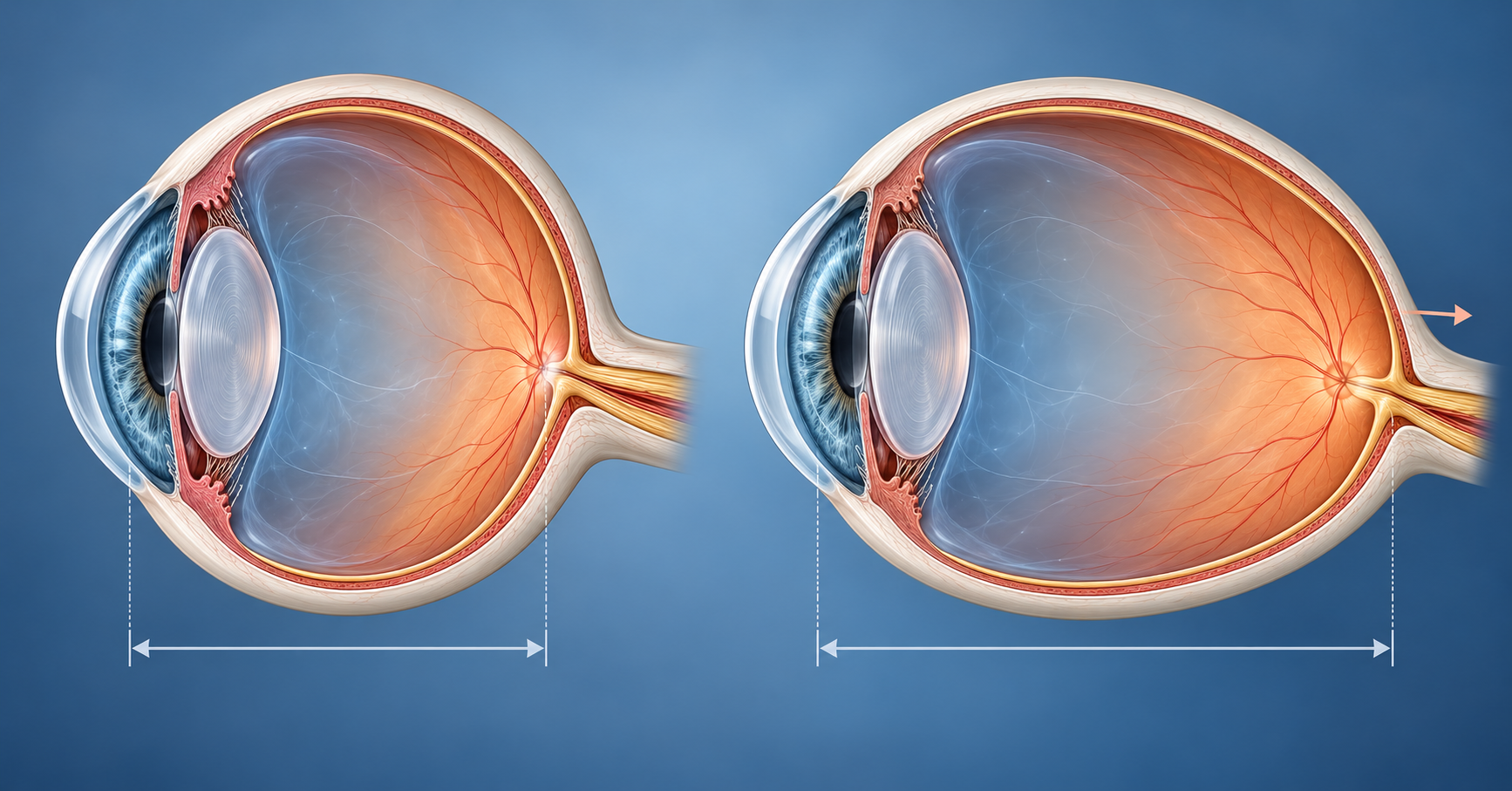
Axial length is the eye’s front-to-back dimension, from the anterior cornea toward the retina. Optical biometers analyze reflected infrared light using interferometry; swept-source OCT instruments also generate sectional images. Ultrasound A-scans calculate distances from returning sound echoes. Optical and acoustic systems detect different retinal interfaces, so their raw measurement endpoints are not identical. DICOM measurement definitions.
The measurement complements refraction; it does not replace an examination. For longitudinal monitoring, record the device, measurement quality, and examination conditions, and use a consistent protocol. An autorefractor that estimates axial length is not necessarily equivalent to a biometer that measures it: a comparative study found substantial differences for one estimated-length system. Comparative study of three instruments.
Which instruments belong on a private-practice shortlist?
| Instrument or category | Documented capabilities | Practice fit | Purchase question |
|---|---|---|---|
| OCULUS Myopia Master | Axial length, autorefraction, keratometry, and myopia reporting. | Myopia-focused practice seeking a combined measurement workflow. | Does it duplicate your existing autorefractor, and which software licenses are included? |
| Topcon MYAH | Optical axial length, corneal topography, pupillometry, contact-lens fitting tools, and meibomian gland imaging. | Practice combining myopia management with specialty contact lenses. | Are the required topography, lens-fitting, and reporting tools included in the U.S. configuration? |
| Haag-Streit Lenstar Myopia | Lenstar 900 biometry combined with EyeSuite Myopia software. | Practice valuing growth visualization, particularly one already owning compatible Haag-Streit equipment. | Can the existing instrument be licensed for the desired workflow instead of replaced? |
| ZEISS IOLMaster 700 | Swept-source OCT optical biometry and cataract-planning capabilities. | Practice with a genuine surgical biometry workload in addition to myopia care. | Which clinical functions and licenses justify the investment for your patient mix? |
| Ultrasound A-scan | Acoustic axial measurement; some systems include IOL calculation software. | Practice with a specific ultrasound indication or backup need. | How will operator technique, patient contact, and repeatability affect serial pediatric measurements? |
Feature sources: OCULUS, Topcon, Haag-Streit, and ZEISS. Features and licensing vary by market and configuration.
What do axial length instruments cost?
Public prices are uneven. The examples below are advertised asking prices, not negotiated quotes, market averages, or endorsements of the seller. New, used, and refurbished instruments are not directly interchangeable purchases.
| Example | Publicly advertised USD price | What it tells you |
|---|---|---|
| Keeler A-Scan Plus Connect | $5,741 promotional price; $6,981 regular price | A manufacturer-listed ultrasound entry point. Confirm computer and accessories. |
| Refurbished ZEISS IOLMaster 500 | $12,825 | A dealer-listed older optical biometer; the listing describes a table and six-month warranty. |
| New Myopia Master, MYAH, Lenstar Myopia, or IOLMaster 700 | Obtain an itemized U.S. quote | No comparable current public manufacturer price was verified for these configurations in this review. |
Price sources: Keeler and Digital Eye Center’s own listing. Verify availability, price, service coverage, calibration, software transferability, and U.S. support before purchase. A lower hardware price can be offset by service or obsolete software.
Compare five-year ownership cost: instrument, table/computer, delivery, training, software renewals, integration, service, financing, and downtime. Request each item separately from competing suppliers.
Our recommendation by practice type
- Starting a pediatric myopia service: demo a myopia-oriented noncontact optical system first. Evaluate acquisition success with children, repeatability, quality flags, and reports parents can understand.
- Adding orthokeratology without an existing topographer: MYAH deserves a place on the shortlist because its documented functions combine axial measurement and topography. Confirm that its fitting workflow supports your lenses.
- Already owning topography: compare Myopia Master and Lenstar Myopia on workflow and total cost rather than paying again for overlapping functions.
- Already owning a Lenstar: investigate an EyeSuite Myopia upgrade first. Haag-Streit describes additional licensing for existing compatible systems; confirm U.S. eligibility and pricing. Manufacturer upgrade information.
- Substantial cataract biometry work: evaluate a surgical optical biometer such as IOLMaster 700 against that broader workload. Pediatric axial measurement alone does not establish the financial case for surgical features.
No single model is best for every private practice. Ask each vendor to demonstrate your actual workflow, including exporting results, retrieving prior visits, and generating a progression report.
U.S. billing codes: measurement is not the same as covered IOL biometry
Do not assume that a device’s ability to measure axial length makes routine myopia monitoring billable under an IOL-calculation code. Select the code for the service actually performed, then check the current code set and the patient’s payer policy.
| Code | Service distinction | Important limitation |
|---|---|---|
| 92136 | Optical biometry including IOL power calculation. | An axial-length-only myopia visit does not by itself establish that the complete coded service was performed. |
| 76519 | Ultrasound A-scan biometry including IOL power calculation. | Not a substitute for optical testing simply because a payer rejects an optical claim. |
| 76516 | Ultrasound A-scan biometry without the IOL-calculation component. | It describes ultrasound, not optical axial measurement; coverage still depends on indication and policy. |
Service distinctions are supported by AMA code documentation; consult the current licensed CPT edition for full descriptors. CPT is a registered trademark of the American Medical Association.
The currently effective CMS contractor article A56549 addresses IOL-power-calculation biometry and includes medical-necessity, component, laterality, and utilization rules. It is jurisdiction-specific, not a universal pediatric myopia coverage policy. Do not automatically bill both methods, duplicate bilateral technical charges, or copy a modifier pattern without checking the applicable payer’s instructions.
For optical axial-length-only monitoring, ask each payer whether it recognizes an applicable code and indication, whether authorization is required, and whether the service is excluded or bundled. Obtain written guidance where possible. A diagnosis code describes the documented condition; it does not create coverage. This guide intentionally supplies no universal reimbursement amount or promised covered code for routine optical myopia monitoring.
Can the practice justify the purchase without assuming insurance payment?
Use conservative scenarios. For example, a hypothetical $25,000 purchase plus $5,000 of ownership expenses over five years creates $30,000 of fixed cost. At $75 of contribution per completed paid visit after variable costs, recovering that amount takes 400 visits, or 80 annually over five years. These are illustrative assumptions, not equipment quotes, recommended fees, or reimbursement estimates. Do not count services twice if axial measurements are already included in a management package.
Before setting patient-pay charges, verify payer contracts and applicable notice requirements. Give families a clear description of included visits and testing, exclusions, and financial responsibility.
What to document at each measurement
Record the indication, device and modality, eye measured, results in millimeters, quality indicators, relevant comparison with prior measurements, interpretation, and management plan. If billing a service requiring an IOL calculation, document that work as well. A printout alone does not explain why a test was ordered or how it affected care.
For the clinical context, see our optometry research update on Ortho-K, atropine, and Neurolens.
Editorial scope: U.S. private-practice purchasing and billing overview, checked October 23, 2026. Product facts come from linked manufacturer materials; price examples come from the seller’s own listings. Individual purchasing and claim decisions require current configuration quotes and the applicable payer rules.