
Research update • October 23, 2026
By Jim Forte, eye-care practice management professional
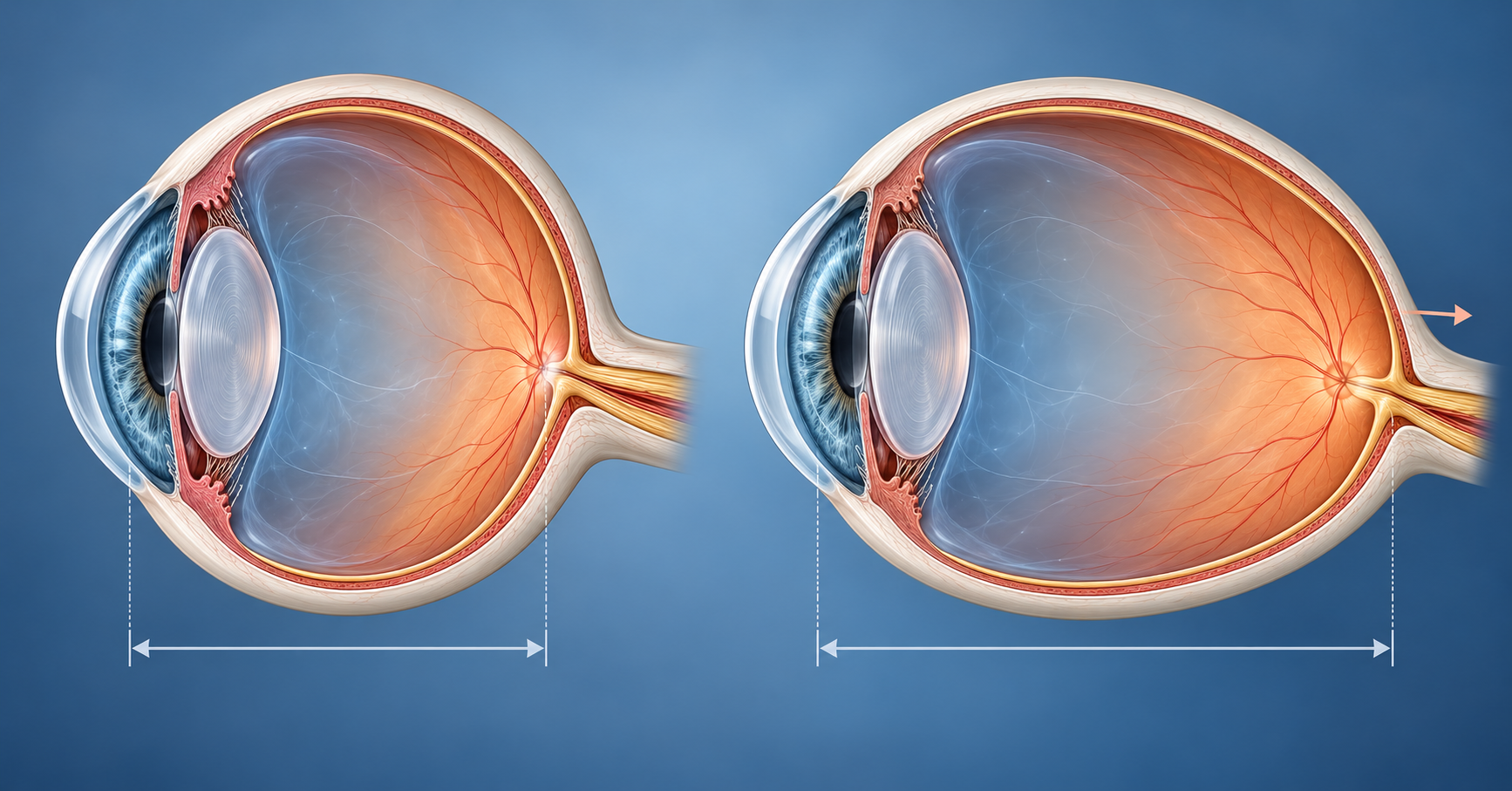
For an eye-care practice managing childhood myopia, the useful question is whether new research changes how patients are monitored, when treatment deserves review, and what families can reasonably expect. This week brings an Ortho-K prediction study, two-year observations on combination treatment, and a corneal safety analysis of low-dose atropine.
The findings support careful measurement and individualized follow-up. Each also has limits that matter when translating a journal result into a conversation with a parent.
Ortho-K: what six-month axial length can tell us
A peer-reviewed analysis published October 23 pooled data from 101 children, average age about nine, who completed two years of orthokeratology follow-up. Fourteen showed axial shortening at six months; their total two-year elongation was approximately 0.12 mm versus 0.45 mm among the other children.
An independent validation group included 69 Japanese children, or 138 eyes. The models distinguished better and worse outcomes reasonably well, but their probability estimates did not transfer reliably. The combined three-category classifier correctly classified approximately 61% of validation eyes.
Evidence assessment: Promising for predicting response, but this was a secondary observational analysis, not a trial of changing treatment based on a prediction. The proposed six-month cutoffs of 0.07 and 0.09 mm are only 0.02 mm apart—near clinical measurement repeatability.
Practice considerations: Use repeated biometry and the overall growth trajectory to inform a six-month treatment review. A single borderline reading should not automatically trigger a change. Whether acting on these predictions improves outcomes remains unanswered.
Disclosure: Menicon paid publication costs; one author is a Menicon employee. Read the Ortho-K primary study.
When atropine alone is insufficient: adding myopia-control spectacles
A prospective cohort published October 19 followed children aged 6–11 whose myopia continued to progress despite low-dose atropine. Fifty enrolled; 48 completed two years after HALT/Stellest spectacles were added.
Mean axial elongation was 0.13 mm in the first year and 0.17 mm in the second. Before combination treatment, the children had averaged 0.24 mm of growth over six months. These are different observation periods and should be read as such.
Evidence assessment: Encouraging, with low certainty about the additional treatment benefit. There was no concurrent control group. Age-related slowing, regression toward average progression, and later changes in atropine dosage or spectacles complicate interpretation.
Practice considerations: These observations support considering optical treatment escalation in children progressing on atropine. They do not establish that this combination outperforms a higher atropine concentration or spectacles alone. The best combination, duration, and stopping strategy need controlled trials.
Disclosure: EssilorLuxottica supplied lenses; authors reported no other conflicts. Read the combination-treatment primary study.
Low-dose atropine and corneal safety
An October 19 peer-reviewed accepted manuscript examined corneal findings in 153 children aged 6–16, randomized to 0.01% atropine or placebo for two years, followed by one washout year.
Investigators found no signal of a treatment-related increase in corneal ectasia. One atropine-treated child developed keratoconus; the authors considered its occurrence compatible with background population rates.
Evidence assessment: Reassuring for the corneal measurements studied, but a cohort this size cannot exclude rare harms. The findings also cannot establish safety at higher atropine concentrations or determine comparative myopia-control efficacy.
Practice considerations: Unexpected astigmatic change or suspicious corneal findings still deserve investigation. A reassuring group result does not explain every individual patient's change.
Disclosure: Academic and charitable research grants supported the work. The accepted manuscript may receive further editorial changes. Read the atropine corneal-safety primary study.
MiSight and Neurolens: keeping the evidence in perspective
No meaningful new primary clinical study of MiSight or Neurolens was verified in this review's October 16–23 search. Older studies appearing in refreshed search results were not counted as new research.
Neurolens background—not a new finding this week: A 2024 randomized, double-masked crossover trial enrolled 195 adults with substantial headache impact; 170 completed it. Participants wore control and Neurolens spectacles for approximately one month each. Neurolens improved the Headache Impact Test score by an average of 1.53 points more than control (95% confidence interval, 0.26–2.80 points better).
The authors considered the average improvement statistically significant but not clinically significant overall, while acknowledging uncertainty about clinically meaningful benefit. Several authors disclosed company employment, consultancy, or investment relationships.
For patient counseling, a statistically detectable average difference should not become a promise of dramatic relief. Important questions include which patients benefit meaningfully and how durable that benefit is. Read the 2024 Neurolens primary trial.
Applying the research in an eye-care practice
Our practical interpretation is to document the patient's starting point, follow change over time, and make the reason for any treatment adjustment explicit. When discussing research, explain the size of the observed benefit, the comparison group, and the uncertainty. That gives families a useful basis for decisions and a realistic understanding of what follow-up is intended to establish.
References
- Santodomingo-Rubido J, Villa-Collar C. Early Axial Length Response Predicts Long-Term Myopia Control in Children Undergoing Orthokeratology. Ophthalmic and Physiological Optics. Published October 23, 2026. doi:10.1007/s44402-026-00224-y.
- Sim BX, Loh K-L, Chan PPL, Sri Y, Chia A. Efficacy of Combined Highly Aspherical Lenslet Target (HALT) Spectacles and Low-Dose Atropine in Children with Poor Response to Atropine Monotherapy over 24 Months. Journal of Clinical Medicine. 2026;15(20):8116. Published October 19, 2026. doi:10.3390/jcm15208116.
- Soh A, Lingham G, Chan E, et al. Corneal biometry changes with 0.01% atropine for myopia control: a randomised controlled trial and case of incidental keratoconus. Scientific Reports. Published October 19, 2026. doi:10.1038/s41598-026-74892-8.
- Labhishetty V, Cortes J, van de Pol C, et al. Impact of Neurolens Use on the Quality of Life in Individuals With Headaches: A Randomized Double-Masked, Cross-Over Clinical Trial. Translational Vision Science & Technology. 2024;13(1):27. doi:10.1167/tvst.13.1.27. Background reference; not new research from October 2026.
About the author
Jim Forte is an eye-care practice management professional with experience in optical practice operations and supporting optometrists. He is not an optometrist or physician. This article is an editorial research summary and has not been independently medically reviewed.
Educational information: American Optometrist publishes educational summaries of eye-care research, with links to original sources. This article includes editorial interpretation and is not a clinical guideline or individualized medical advice. Diagnosis and treatment decisions should be made with a qualified eye-care professional.
One thought on “Optometry Research Update: Ortho-K, Atropine and Neurolens”